Exordium
In Pakistan today, more than 22 million children wake up with no school to go to. For them, the promise written in our Constitution is just ink on paper, a promise that remains locked in legal text while classrooms stand empty.
Education inequality refers to “disparities in the educational opportunities and outcomes of different social groups, often arising from differences in socio economic status, gender, ethnicity, or geography, and resulting in unequal access to quality schooling”
1 . Relation with constitutional framework
Educational inequality in Pakistan is not merely a social challenge; it is a constitutional issue. The Constitution of the Islamic Republic of Pakistan (1973) expressly recognizes education as a fundamental right under Article 25-A, which states:
“The State shall provide free and compulsory education to all children of the age of five to sixteen years in such manner as may be determined by law”. 2
This provision, inserted by the Eighteenth Constitutional Amendment (2010), elevated education from a non-justiciable principle of policy to an enforceable right. 3In addition, Article 25(1) guarantees equality before law and equal protection of law, prohibiting discrimination, while Article 26 ensures non discriminatory access to educational institutions.
Further, Article 37(b) obligates the State to remove illiteracy and provide free secondary education, and Article 38(d) directs it to provide basic necessities, including education. The gap between these constitutional guarantees and the reality ,where over 22 million children remain out of school (UNICEF Pakistan, 2023), transforms education inequality into a breach of the supreme law. 4
Judicial interventions, such as the Sindh High Court’s directives in 2014 to operationalize Article 25-A, underscore the judiciary’s role in translating constitutional promises into actionable reforms. 5Thus, from a legal perspective, addressing educational inequality is both an enforcement of constitutional rights and a fulfillment of Pakistan’s obligations under international instruments, including the Universal Declaration of Human Rights 1948 6and the UN Convention on the Rights of the Child 1989. 7
In Pakistan today, more than 22 million children wake up with no school to go to. For them, the promise written in our Constitution is just ink on paper, a promise that remains locked in legal text while classrooms stand empty.
Education inequality refers to “disparities in the educational opportunities and outcomes of different social groups, often arising from differences in socio economic status, gender, ethnicity, or geography, and resulting in unequal access to quality schooling”
1 . Relation with constitutional framework
Educational inequality in Pakistan is not merely a social challenge; it is a constitutional issue. The Constitution of the Islamic Republic of Pakistan (1973) expressly recognizes education as a fundamental right under Article 25-A, which states:
“The State shall provide free and compulsory education to all children of the age of five to sixteen years in such manner as may be determined by law”. 2
This provision, inserted by the Eighteenth Constitutional Amendment (2010), elevated education from a non-justiciable principle of policy to an enforceable right. 3In addition, Article 25(1) guarantees equality before law and equal protection of law, prohibiting discrimination, while Article 26 ensures non discriminatory access to educational institutions.
Further, Article 37(b) obligates the State to remove illiteracy and provide free secondary education, and Article 38(d) directs it to provide basic necessities, including education. The gap between these constitutional guarantees and the reality ,where over 22 million children remain out of school (UNICEF Pakistan, 2023), transforms education inequality into a breach of the supreme law. 4
Judicial interventions, such as the Sindh High Court’s directives in 2014 to operationalize Article 25-A, underscore the judiciary’s role in translating constitutional promises into actionable reforms. 5Thus, from a legal perspective, addressing educational inequality is both an enforcement of constitutional rights and a fulfillment of Pakistan’s obligations under international instruments, including the Universal Declaration of Human Rights 1948 6and the UN Convention on the Rights of the Child 1989. 7
Provincial and other regions break down – Education Inequality
Punjab: At the primary to higher secondary levels, roughly 27% of children are out of school, amounting to nearly 9.7 million individuals.
Sindh: About 44% of children from primary through higher secondary are not in school, over 7.4 million out-of-school children. Khyber Pakhtunkhwa (KP): Approximately 34% are out of school across all levels, totaling around 4.5 million children.
Balochistan : The situation is most dire,69% of children from primary to higher secondary are out of school, equating to around 3.48 million children.
In Islamabad (ICT), the out-of-school rate is much lower, just 15% across primary to higher secondary, with nearly 89,000 children excluded (47,849 boys; 41,275 girls). In contrast, Azad Jammu & Kashmir (AJK) and Gilgit-Baltistan (GB) present mixed scenarios, both have high enrolment at higher education levels, with AJK approaching urban literacy standards and GB showing strong cultural emphasis on learning despite infrastructural gaps. This underscores that while constitutional guarantees apply uniformly, the realization of the right to education varies sharply by region. 8
Policy-Making and Enforcement Challenges
In Pakistan, the right to education under Article 25-A is a constitutional promise trapped in a maze of fragmented governance. Education is a provincial subject post-18th Amendment, but national policy direction still sits in Islamabad, creating jurisdictional tug-of-war between federal and provincial authorities. Budgets tell the real story: Pakistan spends less than 2% of GDP on education, far below UNESCO’s recommended 4–6%,leaving schools underfunded, teachers underpaid, and infrastructure neglected.
Enforcement is crippled by weak monitoring systems, where ghost schools and politically appointed teachers drain resources without accountability. Policy shifts,like the Single National Curriculum,often focus on uniformity of content rather than equity of access, ignoring the chasm between elite private schools and crumbling public institutions. In rural Sindh, Balochistan, and parts of KP, even the best-written policies collapse under the weight of security concerns, gender norms, and sheer geographic isolation.
Punjab: At the primary to higher secondary levels, roughly 27% of children are out of school, amounting to nearly 9.7 million individuals.
Sindh: About 44% of children from primary through higher secondary are not in school, over 7.4 million out-of-school children. Khyber Pakhtunkhwa (KP): Approximately 34% are out of school across all levels, totaling around 4.5 million children.
Balochistan : The situation is most dire,69% of children from primary to higher secondary are out of school, equating to around 3.48 million children.
In Islamabad (ICT), the out-of-school rate is much lower, just 15% across primary to higher secondary, with nearly 89,000 children excluded (47,849 boys; 41,275 girls). In contrast, Azad Jammu & Kashmir (AJK) and Gilgit-Baltistan (GB) present mixed scenarios, both have high enrolment at higher education levels, with AJK approaching urban literacy standards and GB showing strong cultural emphasis on learning despite infrastructural gaps. This underscores that while constitutional guarantees apply uniformly, the realization of the right to education varies sharply by region. 8
Policy-Making and Enforcement Challenges
In Pakistan, the right to education under Article 25-A is a constitutional promise trapped in a maze of fragmented governance. Education is a provincial subject post-18th Amendment, but national policy direction still sits in Islamabad, creating jurisdictional tug-of-war between federal and provincial authorities. Budgets tell the real story: Pakistan spends less than 2% of GDP on education, far below UNESCO’s recommended 4–6%,leaving schools underfunded, teachers underpaid, and infrastructure neglected.
Enforcement is crippled by weak monitoring systems, where ghost schools and politically appointed teachers drain resources without accountability. Policy shifts,like the Single National Curriculum,often focus on uniformity of content rather than equity of access, ignoring the chasm between elite private schools and crumbling public institutions. In rural Sindh, Balochistan, and parts of KP, even the best-written policies collapse under the weight of security concerns, gender norms, and sheer geographic isolation.
The result? A legal right that exists on paper, a policy framework in perpetual draft mode, and an enforcement mechanism that too often chooses political survival over constitutional duty.
Suggestions
To fulfill Article 25-A, Pakistan must pass enforceable laws mandating free and compulsory education with strict timelines. Provincial education bodies need strengthened legal authority and independent oversight to ensure accountability. Merit-based teacher recruitment should be codified to prevent political interference, and clear penalties imposed for neglect of duties. Legal provisions must guarantee minimum education budgets, prioritizing marginalized regions. Empowering community school committees through statutory powers will enhance transparency and local accountability. Finally, an active judiciary must consistently uphold education rights, turning constitutional promises into real protections for every child.
Conclusion
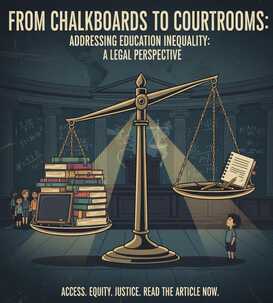
From chalkboards to courtrooms, Pakistan’s education journey reflects a constitutional promise still waiting to be fulfilled. Bridging the gap demands more than policies,it requires political will, financial commitment, and relentless accountability. A nation’s future is built in its classrooms; leaving millions outside the school gate is not just a policy failure,it is a breach of the nation’s moral and legal duty.
Reference
1.(UNESCO, Global Education Monitoring Report, 2022)
2. Constitution of the Islamic Republic of Pakistan 1973 (National Assembly of Pakistan 2023) https://na.gov.pk/uploads/documents/1549886415_632.pdf
3. The Constitution (Eighteenth Amendment) Act 2010 (Government of Pakistan 2010)
http://www.molaw.gov.pk
4. UNICEF Pakistan, Education (UNICEF, 2023)
https://www.unicef.org/pakistan/education
5. Sindh High Court, ‘Operationalizing Article 25-A’ Dawn (Karachi, 24 April 2014)
https://www.dawn.com/news/1101748
6. United Nations, Universal Declaration of Human Rights (UN 1948) art 26
https://www.un.org/en/about-us/universal-declaration-of-human-rights
7. United Nations, Convention on the Rights of the Child (UN 1989) arts 28–29
https://www.ohchr.org/en/instruments-mechanisms/instruments/convention-rights-child
8. Pakistan Education Statistics 2023–24, Out-of-School Children by Province (PES 2024)
https://stateofchildren.com/out-of-school/
Suggestions
To fulfill Article 25-A, Pakistan must pass enforceable laws mandating free and compulsory education with strict timelines. Provincial education bodies need strengthened legal authority and independent oversight to ensure accountability. Merit-based teacher recruitment should be codified to prevent political interference, and clear penalties imposed for neglect of duties. Legal provisions must guarantee minimum education budgets, prioritizing marginalized regions. Empowering community school committees through statutory powers will enhance transparency and local accountability. Finally, an active judiciary must consistently uphold education rights, turning constitutional promises into real protections for every child.
Conclusion
From chalkboards to courtrooms, Pakistan’s education journey reflects a constitutional promise still waiting to be fulfilled. Bridging the gap demands more than policies,it requires political will, financial commitment, and relentless accountability. A nation’s future is built in its classrooms; leaving millions outside the school gate is not just a policy failure,it is a breach of the nation’s moral and legal duty.
Reference
1.(UNESCO, Global Education Monitoring Report, 2022)
2. Constitution of the Islamic Republic of Pakistan 1973 (National Assembly of Pakistan 2023) https://na.gov.pk/uploads/documents/1549886415_632.pdf
3. The Constitution (Eighteenth Amendment) Act 2010 (Government of Pakistan 2010)
http://www.molaw.gov.pk
4. UNICEF Pakistan, Education (UNICEF, 2023)
https://www.unicef.org/pakistan/education
5. Sindh High Court, ‘Operationalizing Article 25-A’ Dawn (Karachi, 24 April 2014)
https://www.dawn.com/news/1101748
6. United Nations, Universal Declaration of Human Rights (UN 1948) art 26
https://www.un.org/en/about-us/universal-declaration-of-human-rights
7. United Nations, Convention on the Rights of the Child (UN 1989) arts 28–29
https://www.ohchr.org/en/instruments-mechanisms/instruments/convention-rights-child
8. Pakistan Education Statistics 2023–24, Out-of-School Children by Province (PES 2024)
https://stateofchildren.com/out-of-school/