
Definition:
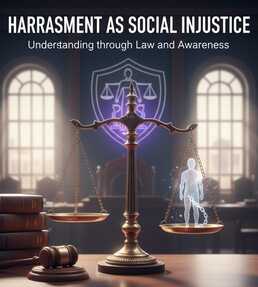
Social injustice refers to the unequal treatment of individuals, often resulting in disparities within society. In simple words, social injustice creates a situation where some groups or individuals are disadvantaged while others benefit disproportionately. Harassment:Although there are various, more evident social injustices present in society, including racism, unequal education, housing, employment, and socioeconomic status. However, the root of all these, most undermined and unseen social injustices with the most diverse negative effects is ‘Harassment.’
Harassment encompasses a broad spectrum of offensive behaviors that humiliate or intimidate an individual. In everyday understanding, it refers to actions or conduct that disturbs, threatens, or create a hostile environment for the individual. It often results in an atmosphere that is degrading, unsafe, or oppressive for the victim in particular.
Harassment as a social injustice, and its understanding is important because it undermines an individual’s dignity, equality, and right to feel safe. Such behavior fosters fear and exclusion, limiting victims’ opportunities in education, work, and public life to feel safe. It perpetuates power imbalances, often targeting vulnerable groups based on gender, class, or identity. in modern society, harassment is being normalized in the name of modernization. Such an approach erodes trust and fairness, weakening the social fabric.
1. Sexual harassment- requests for sexual favors or other physical conduct that negatively impacts the victim’s work, or participation in society. This is recognised under definitions provided by bodies such as the Office of the High Commissioner for Human Rights (OHCHR) and the United Nations.
2. Workplace Harassment- bullying, derogatory remarks, or other conduct, that disrupts employment or makes the workplace unsafe. This is often regulated under labour and anti-discrimination laws, as reflected in the guidance of the International Labour Organization and agencies like the EEOC.
3. Stalking and harassment with threats of violence- unwanted communication, or actions that cause a person to fear for their safety. This often overlaps with criminal offences like stalking, as addressed in many national criminal codes.
4. Cyber or ICT harassment — Abuse conducted via digital means, including online threats, image-based sexual abuse.
Human Rights Perspective:
Harassment is not merely unpleasant behaviour: it is an attack on fundamental human rights. Virtually in all countries, harassments contravene the right to human dignity, physical, and ethical integrity protection, which is extensively enshrined in constitutions and international treaties.
Moreover, the Privacy rights are also breached by sexualised or invasive harassment and can also constitute criminal acts when intimate images are shared without consent.
From the human-rights perspective, nations have the responsibility to protect, prevent, investigate, and prosecute all forms of harassment while also guaranteeing the right to remove barriers to reporting, providing effective access to justice, and victim-focused protections.
2. Workplace Harassment- bullying, derogatory remarks, or other conduct, that disrupts employment or makes the workplace unsafe. This is often regulated under labour and anti-discrimination laws, as reflected in the guidance of the International Labour Organization and agencies like the EEOC.
3. Stalking and harassment with threats of violence- unwanted communication, or actions that cause a person to fear for their safety. This often overlaps with criminal offences like stalking, as addressed in many national criminal codes.
4. Cyber or ICT harassment — Abuse conducted via digital means, including online threats, image-based sexual abuse.
Human Rights Perspective:
Harassment is not merely unpleasant behaviour: it is an attack on fundamental human rights. Virtually in all countries, harassments contravene the right to human dignity, physical, and ethical integrity protection, which is extensively enshrined in constitutions and international treaties.
Moreover, the Privacy rights are also breached by sexualised or invasive harassment and can also constitute criminal acts when intimate images are shared without consent.
From the human-rights perspective, nations have the responsibility to protect, prevent, investigate, and prosecute all forms of harassment while also guaranteeing the right to remove barriers to reporting, providing effective access to justice, and victim-focused protections.
Comparative Analysis:
In Pakistan, the Protection against Harassment of Women at the Workplace Act 2010 imposes workplace duties, establishes complaint committees, and provides administrative redress. However, enforcement often faces challenges such as limited institutional capacity, social stigma, and underreporting due to conservative norms and reputational concerns thereby, leaving gaps in coverage and remedies.
In contrast, Western systems, such as the United Kingdom and the United States, integrate harassment prevention into broader anti-discrimination laws, supported by specialized enforcement bodies. The UK’s Equality Act 2010, the Protection from Harassment Act 1997, and the U.S. Title VII of the Civil Rights Act create comprehensive employer obligations, accessible complaint mechanisms, and strong judicial oversight. Administrative agencies, such as the UK Equality and Human Rights Commission (EHRC) and the U.S. Equal Employment Opportunity Commission (EEOC), actively investigate, issue guidance, and litigate cases, backed by extensive case law that defines employer liability and victim remedies.
Protection:
Considering the above, comparison, it is evident that effective legal protection requires more than statutory text. It further demands robust, well-resourced enforcement institutions, mandatory employer compliance measures, and accessible, victim-sensitive reporting channels. For Islamic-majority states, strengthening and expanding workplace training, integrating criminal and administrative remedies, and protecting whistleblowers could help bridge enforcement gaps. Public awareness campaigns, modeled on Western advocacy movements, can counter social stigma and empower victims to report. Ultimately, the law must operate as both a deterrent and a remedy. This requires harmonizing legal definitions, ensuring procedural fairness, and fostering a societal shift where harassment is recognized not merely as misconduct, but as a violation of dignity, equality, and fundamental rights.
In Pakistan, the Protection against Harassment of Women at the Workplace Act 2010 imposes workplace duties, establishes complaint committees, and provides administrative redress. However, enforcement often faces challenges such as limited institutional capacity, social stigma, and underreporting due to conservative norms and reputational concerns thereby, leaving gaps in coverage and remedies.
In contrast, Western systems, such as the United Kingdom and the United States, integrate harassment prevention into broader anti-discrimination laws, supported by specialized enforcement bodies. The UK’s Equality Act 2010, the Protection from Harassment Act 1997, and the U.S. Title VII of the Civil Rights Act create comprehensive employer obligations, accessible complaint mechanisms, and strong judicial oversight. Administrative agencies, such as the UK Equality and Human Rights Commission (EHRC) and the U.S. Equal Employment Opportunity Commission (EEOC), actively investigate, issue guidance, and litigate cases, backed by extensive case law that defines employer liability and victim remedies.
Protection:
Considering the above, comparison, it is evident that effective legal protection requires more than statutory text. It further demands robust, well-resourced enforcement institutions, mandatory employer compliance measures, and accessible, victim-sensitive reporting channels. For Islamic-majority states, strengthening and expanding workplace training, integrating criminal and administrative remedies, and protecting whistleblowers could help bridge enforcement gaps. Public awareness campaigns, modeled on Western advocacy movements, can counter social stigma and empower victims to report. Ultimately, the law must operate as both a deterrent and a remedy. This requires harmonizing legal definitions, ensuring procedural fairness, and fostering a societal shift where harassment is recognized not merely as misconduct, but as a violation of dignity, equality, and fundamental rights.
Conclusively, Pakistan should strengthen harassment laws through strict enforcement, empowered ombudspersons, and coordinated criminal and administrative remedies. Mandatory workplace training, whistleblower protection, and victim-friendly reporting systems are essential. Nationwide awareness campaigns, community engagement, and educational initiatives can challenge stigma, promote equality, and ensure harassment is condemned as a rights violation.